
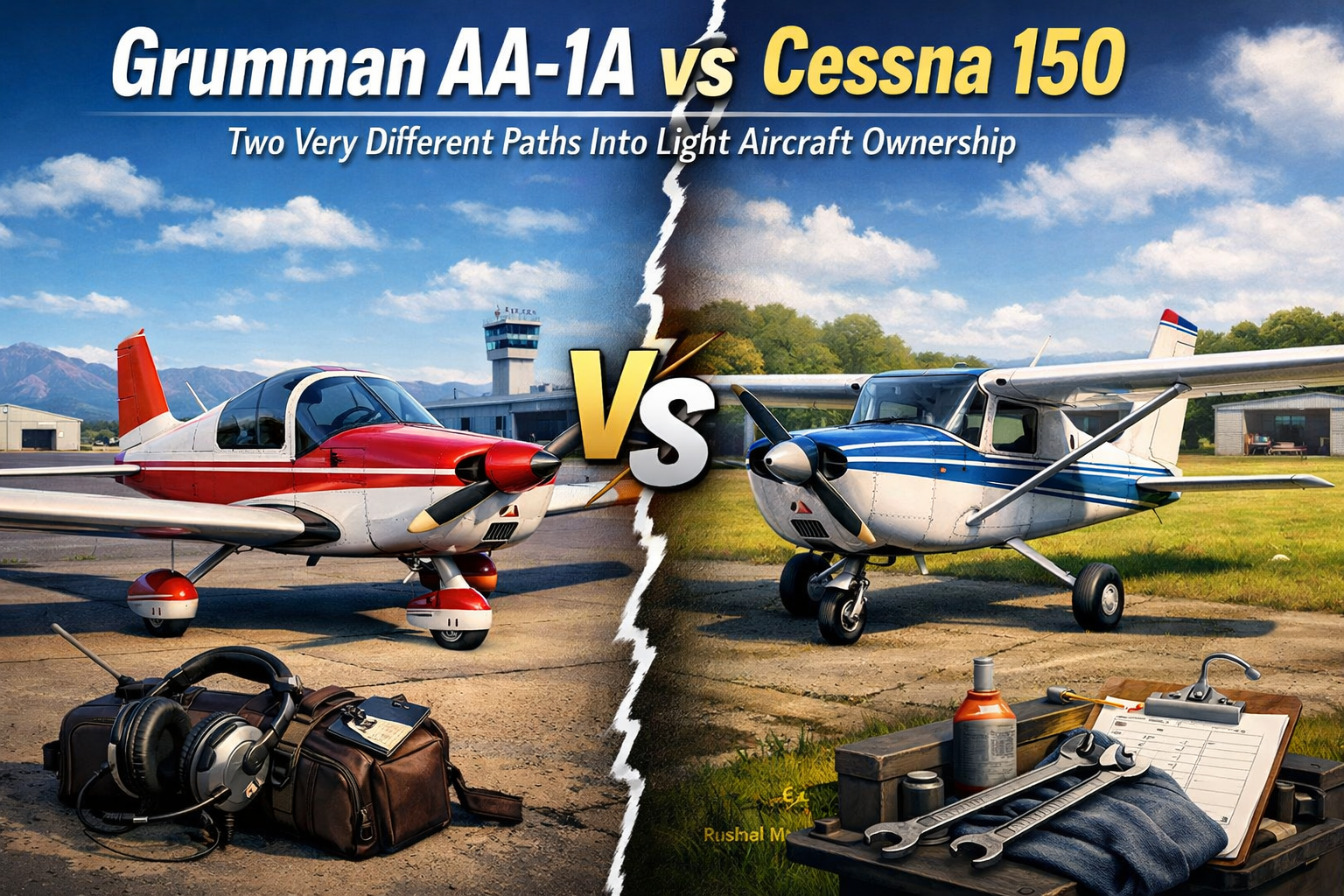
Grumman AA-1A vs Cessna 150: Two Very Different Paths Into Light Aircraft Ownership
Buyers often compare the Grumman AA-1A and the Cessna 150 because both live in the same broad category: small, two-seat piston airplanes that can serve training, time-building, and personal flying. But once you look past that shared category label, the two aircraft reveal very different personalities.
The Cessna 150 is one of general aviation’s most familiar and forgiving reference points. The Grumman AA-1A, by contrast, built its reputation on a cleaner look, a more responsive feel, and a more sporting identity. On HangarVault, this is exactly the kind of comparison that matters because buyers can end up choosing not just between two airplanes, but between two philosophies of ownership.
If your goal is simply to buy the cheapest two-seat airplane available, this comparison will not help much. If your goal is to buy the right airplane for the way you plan to fly, it matters a great deal.
High-Wing Utility vs Low-Wing Character
The Cessna 150 approaches its mission with simplicity and familiarity. Its high-wing layout, broad training history, and forgiving reputation make it one of the most approachable entry points in light aviation. It is the airplane many people imagine when they think of a basic trainer.
The AA-1A approaches the same mission from a different angle. Its low-wing profile, bonded construction, and sharper handling give it a personality that feels more direct. Many pilots find that appealing, but it also means the airplane tends to reward precision more than passivity.
This is not a matter of one aircraft being objectively better in every situation. It is a matter of whether you want docile familiarity or a more engaged flying experience.
Handling and Training Fit
The Cessna 150 became a training icon because it is predictable, stable, and broadly forgiving. It gives students and low-time pilots a platform that rarely surprises them if they stay inside normal technique. That matters in busy school environments and for owners who want a confidence-building airplane.
The AA-1A is also used for training, but it is generally seen as the more responsive and less tolerant airplane of the pair. It is not an unruly aircraft, but it asks for better energy management and cleaner inputs, especially around landing. That sharper personality is exactly why some pilots prefer it.
If you are shopping for a first airplane after training, be honest about your own preferences. Some owners want the airplane that feels easiest. Others want the one that feels more rewarding once flown well.
Ownership and Maintenance Reality
The Cessna 150 benefits from an enormous ecosystem. There are many aircraft in circulation, many mechanics know the type well, and the ownership community is deep. That usually helps with support, pricing references, and maintenance familiarity.
The AA-1A can also be a solid ownership choice, but it rewards type-specific knowledge more strongly. Its bonded construction and distinct design features make the right pre-buy inspection more important. You do not want a generic opinion on an AA-1A when a type-aware mechanic can give you a materially better one.
In other words, the Cessna 150 often wins on infrastructure. The AA-1A can still win on appeal, efficiency, and pilot enjoyment, but buyers should approach it with sharper due diligence.
Mission Fit
If your mission is basic training, local proficiency flying, and simple ownership, the Cessna 150 remains one of the easiest answers in the market. If your mission includes wanting a two-seat airplane that feels a little more distinctive and a little less generic, the AA-1A becomes much more compelling.
The deciding factor is not whether one is famous and the other is interesting. It is whether your ownership goal is maximum ease or maximum personality within the same general size class.
Which One Is Right for You?
Choose the Cessna 150 if you want broad support, familiar training DNA, and one of the least surprising two-seat ownership paths in aviation. Choose the AA-1A if you want a cleaner, livelier airplane and you are willing to be more deliberate about model-specific evaluation and technique.
Both aircraft can be smart buys. They are simply smart for different kinds of owners.